Don't lose your product to prior art your patent search refused to read.
Sovereign technology intelligence for IP and R&D teams, who can't afford to miss a reference.































your patent search alone won't see
indexed this week
per week
classic search approaches
faster path
to a defensible shortlist
no IPC lists
in the search path
your IP never trains anyone's model
What we read that classic search misses
Three document types. One unified, context-matched index. Most patent tools index one of the three. We index all three at once, by meaning.
Patents
EPO, USPTO, and 100+ jurisdictions, all languages, all IPC classes. Catches the Japanese filing that blocks your composition before the office action does.
Scientific papers
Life-science prior art lives in Nature, Cell, Lancet, conference proceedings, and preprints, not just patent databases. Voids your claim before counsel sees it.
Clinical trials
ClinicalTrials.gov, EU CTR, and global trial registries. Pipeline signals from competitors months before press releases or analyst notes pick them up.
It's Tuesday. Your CEO walks in: 'Board on Friday wants FTO sign-off before we lock the IND.' Counsel quotes €15–25K and three weeks for a search built on the same keyword stack that missed something last time. The board meets in four days. And the reference that ends your program is a Japanese filing nobody on the team can read.
Or: term sheet Friday, DD report due Tuesday. Or: cease-and-desist arrived, claim chart due Wednesday. Or: grant deadline Friday, no state-of-the-art yet. Pick yours.
The reference that ends your launch is sitting
in a corpus your tool doesn't index.
The technology that will blindside your team is already in the patent database. The question is whether your foundation can surface it before it surfaces you.
Keyword Search
You need to know every synonym, every IPC class, every language variant ... before you search. Miss one term and you've missed the filing. That's not research. That's luck.
ChatGPT & Public AI
ChatGPT doesn't have access to the patent database. It hallucinates citations that sound real but don't exist. And everything you paste into it may end up in a training set. That's not research. That's a liability.
Kwintely
Paste a paragraph about your technology in plain language. No operators. In 90 seconds you get the global landscape across patents, scientific papers, and clinical trials ... context-matched, not keyword-matched. On our servers. Not theirs. Read by meaning, not keyword.
From a paragraph to a defensible shortlist, in 90 seconds.
No training required. No keyword operators. No setup. Describe your technology and Kwintely returns a ranked, citable shortlist your team can act on.
Describe your technology
Paste a paragraph, an abstract, a patent claim ... anything describing what your technology does. Plain language. No operators needed.
Semantic context maps the landscape
Our agentic AI applies the semantic context search algorithm developed by our founders in 2018 ... searching 295 million documents by meaning, not keywords. Cross-language. Real-time. No hallucinations.
A shortlist your counsel can act on
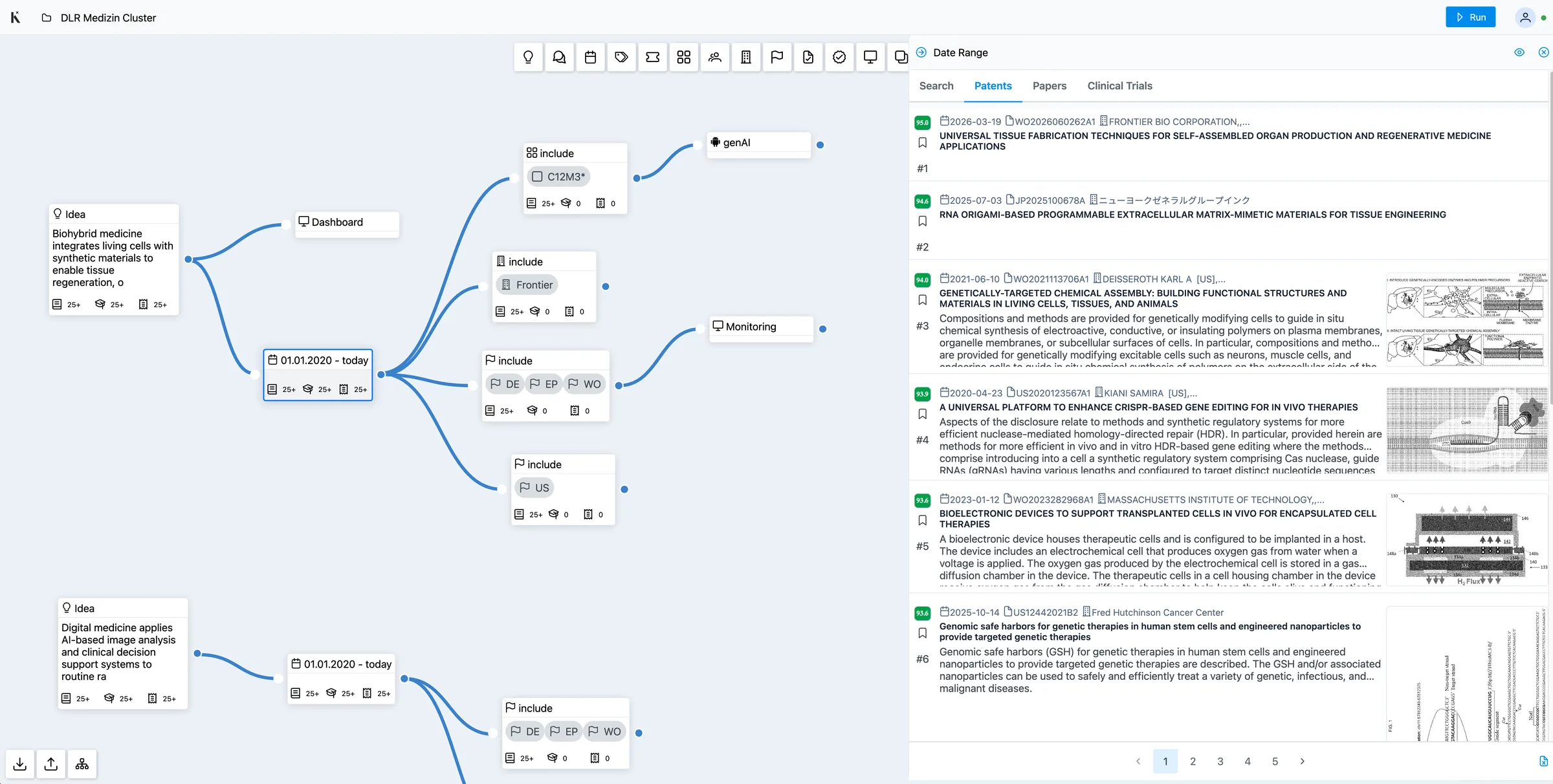
Visual landscape, ranked references with the matched passages, exportable briefing ... ready to take into a board meeting or a clearance-opinion conversation the same day. Ready in under 90 seconds. Shareable immediately.
Twelve jobs. One search.
Every workflow below runs on the same unified index of 295 million patents, scientific papers, and clinical trials ... one search the whole organisation can build on, from C-suite strategy to individual patent cases.
Freedom to Operate
Does your technology infringe existing patents? Get a prioritised blocking patent list before investing in development or market entry ... in minutes, not weeks.
Run an FTO → CasePrior Art & Novelty Search
For patentability, prosecution, IPR, and pre-drafting disclosure review. Context-matched prior art across patents, papers, and clinical trials.
Surface prior art → CaseInvalidity Search
For IPR petitions, patent oppositions, and litigation defense. Element-by-element claim chart of anticipating prior art ... counsel-ready in hours.
Take the patent down → OperationalDynamic Landscaping
Map the full competitive intensity of a technology field ... who is filing where, how fast, and which players dominate which sub-domains. Updated continuously.
Map the field → OperationalCompetitor Monitoring
Automated weekly alerts on competitor patent filings. Stop learning about competitor moves from press releases. 320,000 new documents indexed every week.
Track competitors → OperationalTechnology Surveillance
Continuous monitoring of a technology domain ... not just competitors but the entire field. New entrants, unexpected filings, cross-disciplinary signals.
Watch the domain → OperationalState of the Art
Grant proposals, regulatory submissions, due diligence reports. Sub-topic-clustered citation set in 90 seconds, BibTeX / EndNote / Word ready.
Generate the citations → StrategyForesight & Technology Trends
Where is the technology going? Emerging filings, whitespace identification, and cross-domain signal detection for R&D roadmapping decisions.
Read the trajectory → StrategyBoard Briefing
Brief the board on Thursday in 90 seconds. Synthesises foresight, landscape, and competitor signals into a board-ready slide pack with speaker notes.
Brief the board →One intelligence layer.
Every deep tech vertical.
The same unified index of 295 million patents, scientific papers, and clinical trials ... applied to the specific questions that matter in your industry. Select your vertical to go deeper.
Life Science
Pharma
Biotech
Robotics
Materials
+2
Sustainability
+1
Agri Tech
Infrastructure
Three ways to work with Kwintely
Pick the path that matches where you are with in-house tooling and expertise. Most customers start on one path and grow into others over time.
SaaS Platform License
Full self-serve access for your in-house experts. R&D and IP teams run their own searches, build their own landscapes, and own their research workflow. The most common way to work with Kwintely.
For: Head of R&D · Head of IP · innovation teams who want control
Research Services & Projects
We run the analysis and deliver results. Briefing-ready FTO assessments, competitive landscapes, prior-art reports. Scoped consulting engagements for technology due diligence, white-label research, and competitive intelligence. No platform licence required.
For: IP counsel on high-stakes cases · CTO who needs an external view · teams without in-house capacity · strategy & due-diligence workflows
API & MCP Interface
Kwintely's patent and science intelligence as a sovereign data layer in your agentic AI workflows. REST API or MCP server, connect directly to your internal tools without routing IP data through third-party infrastructure.
For: CTO · engineering teams building agentic AI · innovation labs
A common customer journey: start with a research engagement to prove the value on one real question, move to a SaaS subscription once the team is convinced, graduate to API or MCP integration once Kwintely becomes part of your internal workflow.
Pick the path closest to your starting point. You can switch any time, most teams start where their first urgent question lives.
In their words.
Before KWINTELY there was 90% noise. Now I get 90% signal. Your platform is the missing piece for ad-hoc evaluation in my innovation workshops.

KWINTELY just saved us 3 months time identifying the white spot in the patent landscape. Plus, it found documents highly relevant but unknown.

The results are very good. Among the first 10 results, 6 hits were spot on. Impressive, because compiler structures is quite a niche for prior art research.
In good company.
Deep-tech R&D and IP teams alongside the public institutions and accelerators that backed Kwintely from day one.







Full data sovereignty.
Built in, not bolted on.
We built our own AI infrastructure from the ground up. No OpenAI API. No shared models. No third-party processing. For deep tech companies where IP is the asset, sovereignty over research data isn't optional ... it's the baseline.
- Own AI models ... no OpenAI, no Anthropic, no Google APIs in the search path
- German data centre ... subject to German and EU law
- Sovereign by architecture, not by compliance checkbox
- Your searches never train anyone else's model
- No IP description ever touches a third-party inference endpoint


We felt the gap.
Then we built the foundation.
"In 2016, we spent two months on a keyword-based patent search for a deep tech project we were working on. The results were incomplete. The methodology was flawed. We knew it and had no way to fix it.Dr. Lennart Weiß & Dr. Hardy Köke · Co-Founders · Braunschweig, Germany
So we developed our own algorithm ... semantic context search. Instead of matching keywords, it matches meaning. In 2018 we launched Kwintely on top of it.
We're both engineers. We know what decisions made without the right intelligence layer cost ... not in euros but in direction. We built Kwintely to be the foundation serious IP and R&D work deserves. Agentic. Sovereign. Ours."
Fighting bad search results since 2018.
Compared to the tools you already use
Google Patents and Espacenet are keyword tools. You need to know the exact language the patent used before you search ... every synonym, every IPC code, every language variant. Miss one and you've missed the filing. Kwintely uses semantic context search ... an algorithm our founders developed ... to start from your technology description and find relevant patents by meaning, not by keyword. Same database, completely different hit rate.
It depends on how you deploy Kwintely. As an API or MCP layer inside your existing workflow, Kwintely is the intelligence underneath PatSnap, Lens.org or Google Patents, same 295M-document index, context-matched, your existing tool still handles what it's good at (claim-level analysis, litigation support). As the licensed SaaS platform, Kwintely replaces those tools: classical boolean search, context search, and combined boolean + context filters in one workflow, so you're not paying for two overlapping toolsets. Same search quality in both paths; the difference is the integration surface.
ChatGPT does not have access to the patent database. It generates citations that sound plausible but frequently do not exist ... a serious problem when you're making IP strategy decisions. Additionally, everything you paste into ChatGPT may become training data. Feeding it your technology description before a filing is a confidentiality risk most IP counsel would advise against. We'd rather show you what real technology intelligence looks like.
Data sovereignty is built into our architecture, not added as a compliance layer. Nothing you search with Kwintely touches a shared model or external endpoint ... our agentic AI runs entirely on our own servers in Braunschweig, Germany, under German and EU data protection law. For deep tech companies where the IP description itself is sensitive, that's the only acceptable answer.
We process 320,000 new entries every week across all three document types. The unified index currently covers 295 million documents: global patents from 100+ patent offices (EPO, USPTO, WIPO, and national offices), scientific papers, and clinical trials ... all in a single context-matched search. For competitive monitoring, we provide weekly briefings on new activity in your domain.
The same two people who built it. Lennart and Hardy answer support directly ... there is no helpdesk between you and them, by design, while the company is small enough that the trade-off is worth it. You email kontakt@kwintely.de or hit a wall mid-search and the response comes from the engineers who wrote the algorithm, not a tier-one queue.
Bring the question that's
costing you time.
Fifteen minutes with a founder. You'll know which use case is yours and how to start.